preguntar qué agua

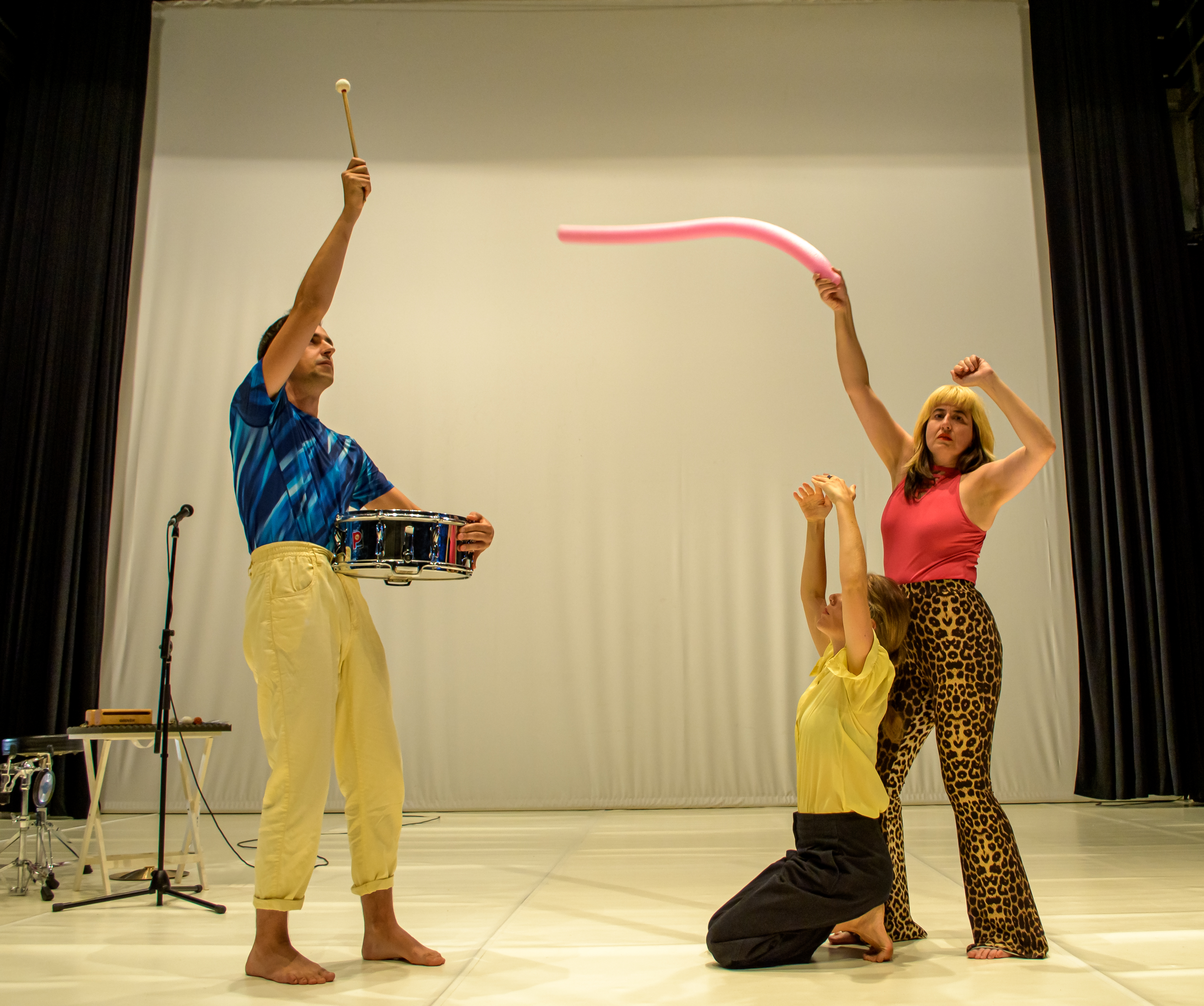
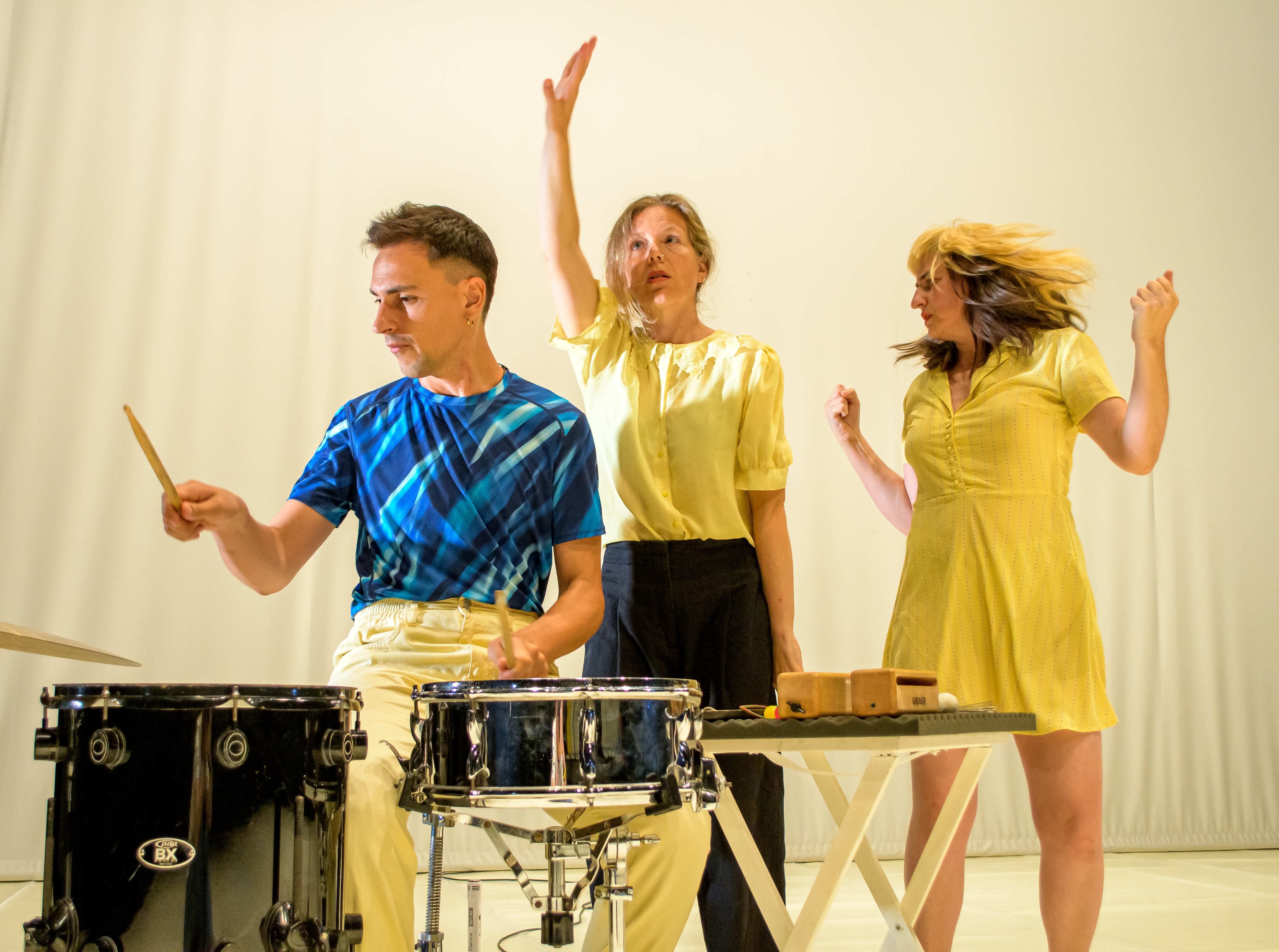
A combination of dance, experimental music, sound poetry, and performance art that blurs the boundaries between improvisation and composition; it is a sequence of unconventional visual and sonic scores that guide the action while leaving room for free interpretation and creative decision-making. Its performers begin with actions that challenge traditional structures, where each gesture becomes a mutable decision and bodies do not assume fixed roles; instead, these performers of movement, word, and percussion continuously transform in a multifocal and dynamic interaction between the predetermined and the spontaneous.

Lorena Izquierdo, action poetry

Ilaria Orlandini, movement

Andrés Navarro García, percussion

MONTAGNES

Montagnes, “mountains” in english, is the encounter between the artist and different acoustic contexts. The artist, in the ecosystem, with his instrument, moves in search of spaces where to improvise. Each sound triggered by the artist appears endowed with a singularity and richness unique to each environment, only possible in a context far from the sound pollution of the city. The sounds of the ecosystem and their resonances are in dialogue with the sounds of the instrument and vice versa.

The project positions the artist in a personal exercise. The search for the necessary openness during improvisation that allows him to enter into a constant dialogue with the space. The appeasement of the ego that will give place to the connection with the environment.

GRAY [extended]

It is a hybrid room built with aural and gestural images.

The performance is built anew, each iteration to be shaped by the space we inhabit, surrounding and transforming it for a long duration of time.

Anika Edström Kawaji (danse), Victor Guaita Igual (viola) and Andrés Navarro García (percussion).

mantra 50Hz

A mantra is a mental formula that protects. It consists of one or more syllables that are chanted in a loop. Buddhist lama Anagarika Govinda calls mantras “mental tools… tools of the mind”. There is a concret mantra that accompanies us day and night, our lives oscillate around it, it is the mantra of electricity waves, a tone of 50Hz. This tone and its multiples are present all the time in our daily lives : in our kitchens and laundries, in the artificial light or in the tram.  Discoveries have shown that anything that vibrates reacts to vibrations, even to most minute vibrations, brainwaves for instance. So, how do we perceive those tones ? Do we have a special bond with them or not ? 

mantra 50Hz is a performance created by Andrés Navarro García and Damien . All the sounds are produced in live by the use of founded electric devices. These are activated on drum and cymbal surfaces, that serve as resonance bodies, and amplified. The audience encounters a nearly statique drummer as a result, contrasting with the wide range of sounds produce by those devices.

The electric sounds that until now we had perceived consciously or not were only the surface of a huge sonic ocean. Thanks to the electroacoustic amplification system use during the performance, the audience will be able to submerge and know this hidden ocean below the daily life surface. 

CONSTRUCTION SITE

A collaboration between the sounds of percussion instruments, electronic music and the metallurgical industry.

Jérome Lefèvre’s metallurgical work sets the scene for the sounds of construction. Welding, cutting, grinding, hammering… a creative process that becomes part of the performance, and materializes in metal objects; objects that become instruments when they are added to the instrumental set played by Andrés Navarro during the performance. Rotterdam-based sound designer Javi Herrero will add an extra dimension to the performance with his live electronics.

Jérome Lefèvre, metalworks
Javi Herrero, live electronics
Andrés Navarro García, percussion

PERCUSSIONIST SONGS

Andrés Navarro explores the western concept of “song” through a collection of contemporary pieces for percussion and voice. 

What do we understand by song ? 

Percussionist songs is based on the basic elements that make up our preconceived idea of “song”: the voice, the verse and the ephemeral. These three elements are dissected during the performance under the compositional aesthetics of the American composers Christian Wolff, Pauline Oliveros, Alvin Lucier and John Cage.

QUIXTET

Beats of all times About the earliest music of all time, musicologists can only guess. There are no scores, there are no written sources, and with archaeological finds it is often unclear in what way objects could have had a function as musical instruments. So we do not know for sure what the first music might have sounded like, but we do know that music was always made. One of the most primary ways of making sound is by tapping or rubbing objects against each other, which today we would call percussion. Once there are two consecutive sounds, we can speak of rhythm and tempo. If the time interval between several rhythmic impulses is stable, there is a ‘beat’, a heartbeat in the same way that our heart pulses at a more or less constant speed.

https://quixtet.org/

SKEW

It is a an international collective consisting of 11 improvisers living in Brussels and France. We come together around the desire to deepen a primordial research concerning the practice of non-idiomatic improvisation.

What characterises the collective is its open nature based on discursive exchange without a leader. The project engages in collective improvisation in the form of “solo parallels“, where several musicians play together while each one retains their solo. There are a number of ideas behind this artistic direction:

1) the essence of musical improvisation lies above all in deepening solo improvisation.
2) to avoid the risk of idiomatising non-idiomatic improvisation, we can’t imagine any other effective means apart from reflecting on the idiomatic itself.
3) the artistic is always linked to the socio-cultural. This becomes obvious
through listening attentively to the incomprehensible and the elusive, as well
as in the practice of sharing.

SKEW was born out of a series of workshops by Seijiro Murayama (Japan, 1957) and
consists of:
Hugo Abraham (double bass)
Cyprien Busolini (viola)
David Eyguesier (electric guitar)
Roger Fähndrich (e. guitar, voice)
Marcello Giannandrea (bassoon)
Victor Guaita (viola)
Mathieu Lilin (baritone sax)
Mattia Massolini (double bass)
Seijiro Murayama (percussion, voice)
Andrès Navarro (percussion)
Ana Simon (flute)

SD with Maximilian Glass

Andrés Navarro and Maximilian Glass are transforming by listening and shaping by playing. Both are using each one snare drum as a starting point for a common creation of a direct and intuitive language. While exploring the wide range of possibilities the instrument offers, the duo is composing in real time by implementing extended techniques accompanied by motors, contact mics, objects, sticks and bows…

ESPACE

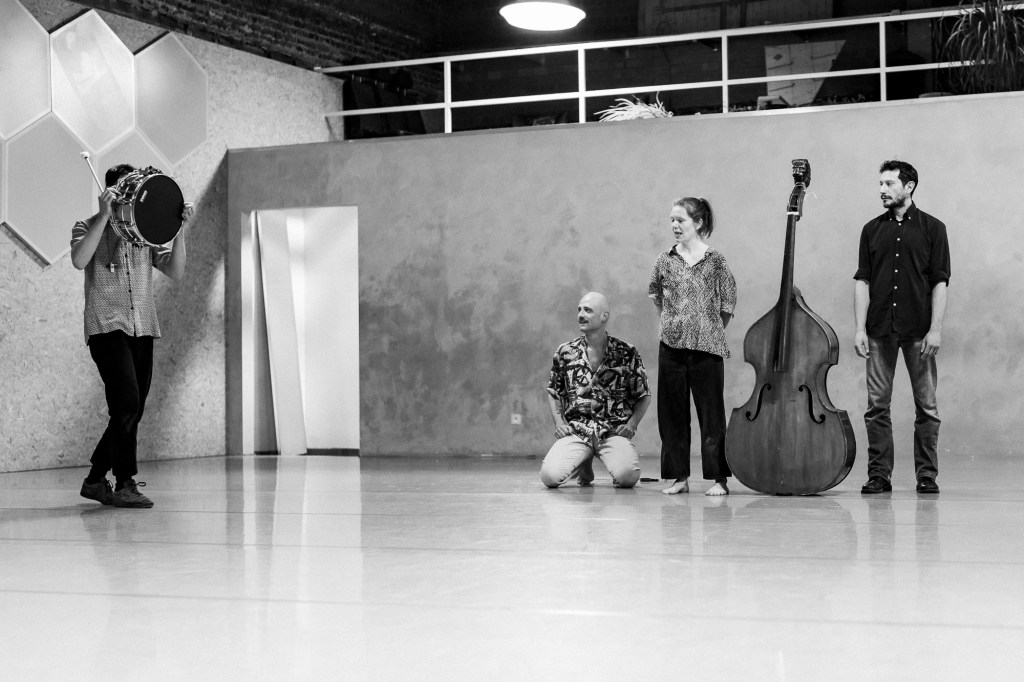
Espace is a multidisciplinary project formed by 4 Brussels-based artists. They are interested in improvisation (sound and movement). Mattia Massolini (double bass), Ilaria Orlandini and Theo Marion-Wuillemin (dance) and Andrés navarro García (percussion).

Espace calls into question our relationship with visible and invisible space. It is a research and a performance that questions the human being in its relation with other forms of life. It’s a succession of events and decisions that follow the flow of the present moment: movements, sounds, dance and music.